
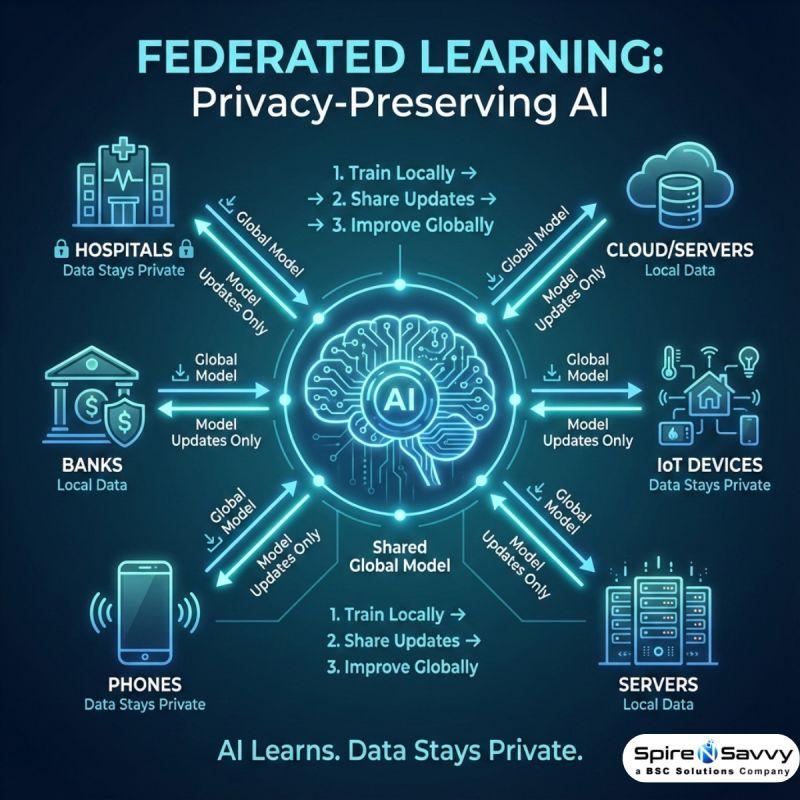
Federated Intelligence Ecosystems: Distributed AI Without Centralized Data
As artificial intelligence becomes increasingly integrated into business operations, healthcare systems, financial services, and smart infrastructure, the demand for high-quality data continues to grow. Traditionally, AI models have relied on centralised datasets, requiring organizations to collect and store vast amounts of information in a single location. While effective for training powerful models, this approach raises significant concerns related to privacy, security, regulatory compliance, and data ownership. In response, a new paradigm is emerging: Federated Intelligence Ecosystems, where distributed AI systems collaborate without requiring centralised data repositories.
Federated intelligence builds upon the principles of federated learning, a machine learning approach that enables AI models to learn from data located across multiple devices, organizations, or environments. Instead of transferring sensitive information to a central server, the data remains at its source while only model updates, insights, or learned parameters are shared. This allows collective intelligence to emerge without compromising data privacy.
The concept represents a major shift in how artificial intelligence is developed and deployed. In a federated ecosystem, hospitals, banks, research institutions, manufacturers, and other organizations can collaborate to improve AI performance while maintaining control over their data. This approach is particularly valuable in industries where data confidentiality is critical and regulatory requirements are strict.
One of the key advantages of federated intelligence is privacy preservation. Sensitive personal, financial, or medical information never leaves its original location, reducing exposure to data breaches and unauthorised access. This aligns closely with modern regulatory frameworks such as the European Union General Data Protection Regulation (GDPR) and emerging global privacy standards.
Healthcare provides a compelling example of this model. Multiple hospitals can train a shared diagnostic AI system using patient records stored locally at each institution. The resulting model benefits from diverse datasets while protecting patient confidentiality. Similar opportunities exist in fraud detection, predictive maintenance, and smart city management.
Organizations such as Google and NVIDIA are actively advancing federated learning technologies and distributed AI frameworks, demonstrating the growing importance of collaborative intelligence without centralised data collection.
Another significant benefit is resilience. Federated ecosystems eliminate the dependency on a single data repository, reducing the risks associated with centralised failures, cyberattacks, and infrastructure outages. Intelligence becomes distributed, scalable, and adaptable across multiple participants.
However, federated intelligence also introduces challenges. Coordinating AI models across diverse environments requires sophisticated orchestration mechanisms, secure communication protocols, and standardised interoperability frameworks. Model consistency, performance optimisation, and trust management remain active areas of research.
Security is equally important. Although raw data remains decentralised, model updates themselves can become targets for adversarial attacks or manipulation. Advanced encryption, secure aggregation techniques, and zero-trust architectures are essential for protecting federated ecosystems.
The future of AI is likely to become increasingly collaborative. As organizations seek to balance innovation with privacy and compliance, federated intelligence ecosystems offer a practical path forward. They enable collective learning while preserving sovereignty over data assets.
In conclusion, federated intelligence ecosystems represent a new era of distributed artificial intelligence. By enabling organizations to collaborate without centralising sensitive data, these systems combine privacy, scalability, and innovation in a way that aligns with the evolving demands of the digital economy. As AI adoption accelerates, federated intelligence may become one of the foundational architectures of the next generation of trustworthy and responsible artificial intelligence.
#FederatedIntelligence #FederatedLearning #ArtificialIntelligence
#DistributedAI #PrivacyPreservingAI #MachineLearning #DataPrivacy
#CyberSecurity #DigitalTransformation #FutureTech #ResponsibleAI
#AIInnovation
Author
Dr. Akhilesh Kumar
References
- Google. Research on Federated Learning and Privacy-Preserving Artificial Intelligence.
- NVIDIA. Distributed AI and Federated Intelligence Frameworks.
- European Union. General Data Protection Regulation (GDPR) and Data Privacy Principles.
- Institute of Electrical and Electronics Engineers. Research on Federated Learning and Distributed Machine Intelligence.