
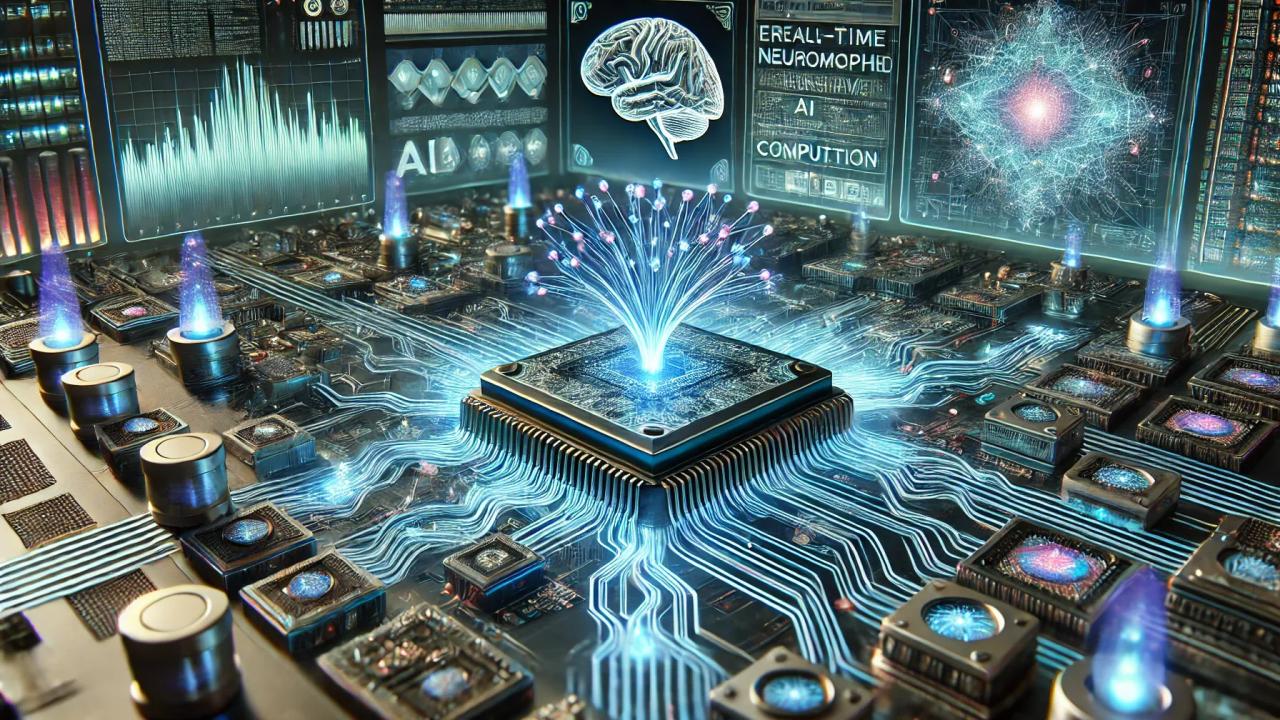
Neuromorphic Chips: Supercharging Computing Beyond Moore's Law
For more than five decades, the computing industry has relied on Moore’s Law, the observation that the number of transistors on a chip would roughly double every two years, driving exponential improvements in performance and efficiency. However, as semiconductor technology approaches physical and economic limits, the industry is searching for new ways to sustain computational growth. One of the most promising innovations is neuromorphic computing, a revolutionary approach that designs computer chips to function more like the human brain.
Unlike conventional processors that separate memory and computation, neuromorphic chips integrate these capabilities in ways inspired by biological neural systems. The human brain contains approximately 86 billion neurons connected through trillions of synapses, enabling remarkable efficiency, adaptability, and learning capabilities while consuming only a fraction of the energy required by modern supercomputers. Neuromorphic architectures seek to replicate these characteristics in silicon.
Traditional computing systems process information sequentially and often require significant energy to move data between memory and processing units. Neuromorphic chips use networks of artificial neurons and synapses that communicate through event-driven signals, similar to biological brain activity. This enables highly parallel processing while dramatically reducing energy consumption.
The implications for artificial intelligence are significant. Modern AI systems often require enormous computational resources for training and inference. Neuromorphic hardware offers the potential to execute intelligent workloads more efficiently, particularly in edge computing environments where power and latency constraints are critical. Devices such as autonomous vehicles, drones, robotics platforms, and smart sensors could benefit from real-time intelligence without depending heavily on cloud infrastructure.
Organizations such as Intel and IBM have invested extensively in neuromorphic research, developing experimental processors designed to mimic neural behavior and support next-generation AI applications. These efforts are helping researchers explore new computing paradigms beyond traditional architectures.
Another major advantage of neuromorphic systems is adaptability. Unlike conventional processors that execute predefined instructions, neuromorphic chips can support continuous learning and dynamic decision-making. This makes them particularly suitable for environments where conditions change rapidly and autonomous responses are required.
Energy efficiency is perhaps the most compelling benefit. As data centers and AI workloads consume increasing amounts of electricity, organizations are seeking sustainable alternatives. Neuromorphic architectures have the potential to deliver high-performance computing while significantly reducing power consumption, making them attractive for both commercial and environmental reasons.
Applications extend far beyond artificial intelligence. Neuromorphic systems may support advanced cybersecurity, healthcare diagnostics, industrial automation, scientific simulations, and next-generation human-computer interfaces. Their ability to process sensory information efficiently makes them particularly effective for vision, speech, and pattern-recognition tasks.
Despite their promise, neuromorphic technologies remain in an early stage of development. Programming models, software ecosystems, and industry standards are still evolving. Developers must rethink traditional approaches to algorithm design and system architecture to fully leverage neuromorphic capabilities.
Scalability and interoperability also remain important challenges. Integrating neuromorphic processors with existing computing infrastructure requires new frameworks and tools capable of bridging conventional and brain-inspired architectures.
In conclusion, neuromorphic chips represent one of the most exciting frontiers in computing innovation. By drawing inspiration from the extraordinary efficiency of the human brain, these technologies offer a path beyond the limitations of Moore’s Law. As research continues and practical applications emerge, neuromorphic computing may redefine how intelligent systems are built, enabling a future where machines think, learn, and adapt with unprecedented efficiency.
#NeuromorphicComputing #NeuromorphicChips #ArtificialIntelligence
#FutureTech #SemiconductorTechnology #BrainInspiredComputing
#AIHardware #EdgeComputing #DigitalTransformation #Innovation
#MooresLaw #NextGenerationComputing
Author
Dr. Akhilesh Kumar
References
- Intel. Neuromorphic Computing Research and Brain-Inspired Hardware Development.
- IBM. Cognitive Computing and Neuromorphic Architecture Studies.
- Institute of Electrical and Electronics Engineers. Research on Neuromorphic Systems and Emerging Semiconductor Technologies.
- Association for Computing Machinery. Studies on Brain-Inspired Computing and Advanced AI Hardware.