
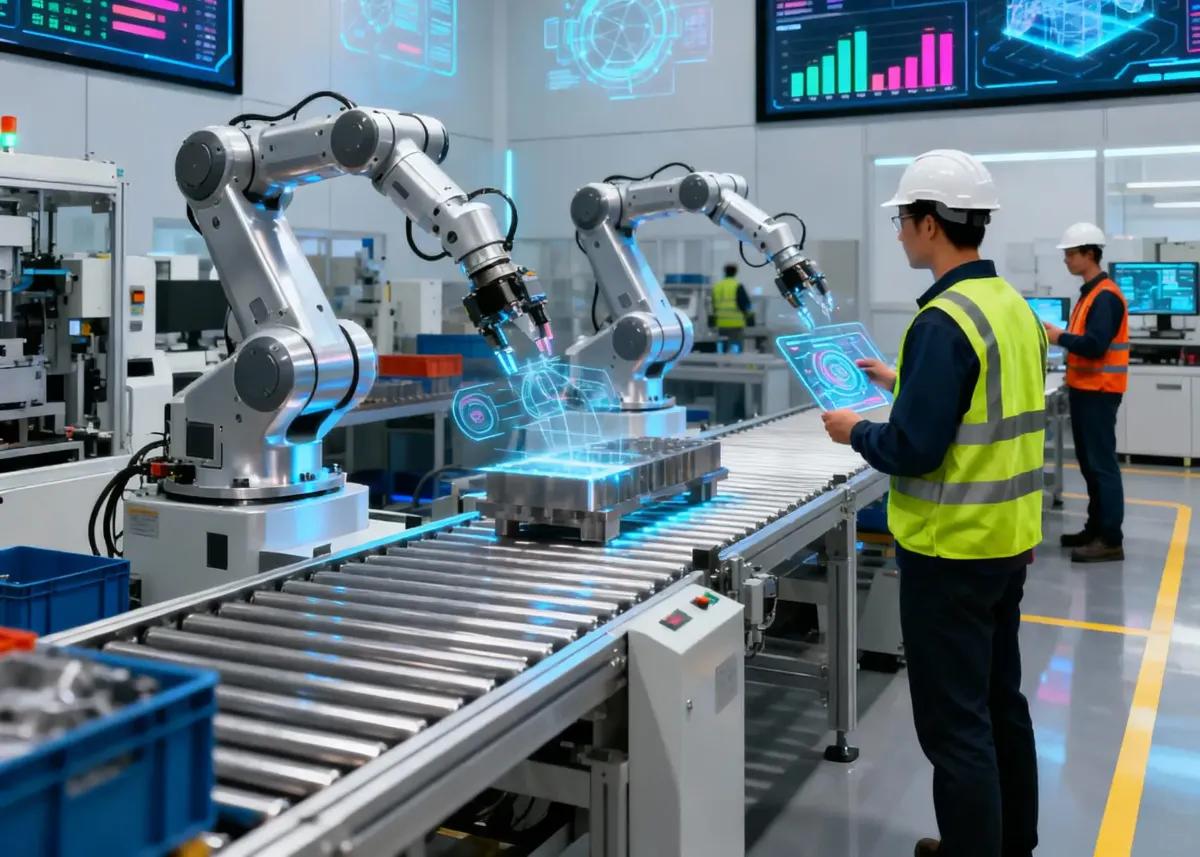
Physical AI: Automating 50% of Manual Industrial Tasks by 2028
Artificial intelligence has already transformed how organizations process information, analyse data, and automate digital workflows. However, the next major evolution is moving beyond software and into the physical world. This emerging field, known as Physical AI, combines artificial intelligence, robotics, computer vision, sensor technologies, and autonomous decision-making to enable machines to interact with and operate within real-world environments. By 2028, many industry experts believe Physical AI could automate up to 50% of repetitive and manual industrial tasks, reshaping manufacturing, logistics, construction, and infrastructure operations.
Unlike traditional AI systems that operate primarily in digital environments, Physical AI enables intelligent machines to perceive, understand, and respond to physical surroundings. These systems can navigate complex environments, manipulate objects, collaborate with humans, and adapt to changing operational conditions in real time. The result is a new generation of intelligent industrial automation that extends far beyond conventional robotics.
Historically, industrial automation relied on fixed robotic systems programmed to perform highly specific tasks. While effective in controlled environments, these systems lacked flexibility and adaptability. Physical AI changes this by allowing machines to learn from experience, interpret sensor data, and make autonomous decisions. This capability is particularly valuable in industries where tasks vary frequently and environments are unpredictable.
Manufacturing remains one of the most promising application areas. Intelligent robotic systems can handle material movement, assembly processes, quality inspections, and equipment maintenance with increasing levels of autonomy. Physical AI allows robots to adapt to product variations and changing production requirements without extensive reprogramming.
Organizations such as NVIDIA and Tesla are actively advancing Physical AI platforms that combine machine learning, simulation technologies, and robotics to create highly capable autonomous systems. These innovations are accelerating the deployment of intelligent machines across industrial sectors.
Logistics and supply chain operations are also experiencing significant transformation. AI-powered robots can sort packages, manage inventory, optimise warehouse workflows, and coordinate transportation systems more efficiently than traditional automation technologies. This improves productivity while reducing operational costs and delays.
One of the key drivers behind Physical AI adoption is workforce augmentation. Many industries face labor shortages, aging workforces, and increasing safety concerns. Intelligent machines can perform repetitive, hazardous, or physically demanding tasks, allowing human workers to focus on supervision, problem-solving, and strategic decision-making.
Safety and efficiency improvements are particularly important in sectors such as mining, energy, construction, and infrastructure maintenance. Autonomous systems can operate in environments that may be dangerous or inaccessible to human workers, reducing risk while improving operational continuity.
However, widespread deployment of Physical AI also presents challenges. Reliable perception, environmental understanding, and real-time decision-making remain complex technical problems. Organizations must ensure that autonomous systems operate safely, predictably, and transparently in dynamic environments.
Cybersecurity is another critical consideration. As industrial systems become increasingly connected and autonomous, protecting Physical AI infrastructure from cyber threats becomes essential. Secure communication, identity management, and continuous monitoring will play key roles in maintaining operational resilience.
The workforce impact must also be managed carefully. While Physical AI is expected to create new opportunities in robotics, AI engineering, and intelligent operations management, organizations must invest in workforce reskilling and adaptation programs to support a smooth transition.
In conclusion, Physical AI represents the next frontier of industrial transformation. By bringing intelligence into the physical world, organizations can automate complex tasks, improve safety, and increase operational efficiency at unprecedented levels. As technology continues to mature, Physical AI is poised to become a foundational component of Industry 5.0, where humans and intelligent machines work together to build smarter, more resilient industrial ecosystems.
#PhysicalAI #ArtificialIntelligence #IndustrialAutomation #Robotics
#Industry50 #SmartManufacturing #FutureOfWork #AutonomousSystems
#DigitalTransformation #IndustrialInnovation #HumanRobotCollaboration
#FutureTech
Author
Dr. Akhilesh Kumar
References
- NVIDIA. Research on Physical AI, Robotics Simulation, and Autonomous Systems.
- Tesla. Development of Intelligent Robotics and Autonomous Industrial Technologies.
- International Federation of Robotics. Global Industrial Robotics and Automation Reports.
- Institute of Electrical and Electronics Engineers. Research on Robotics, Autonomous Systems, and Industrial AI.