
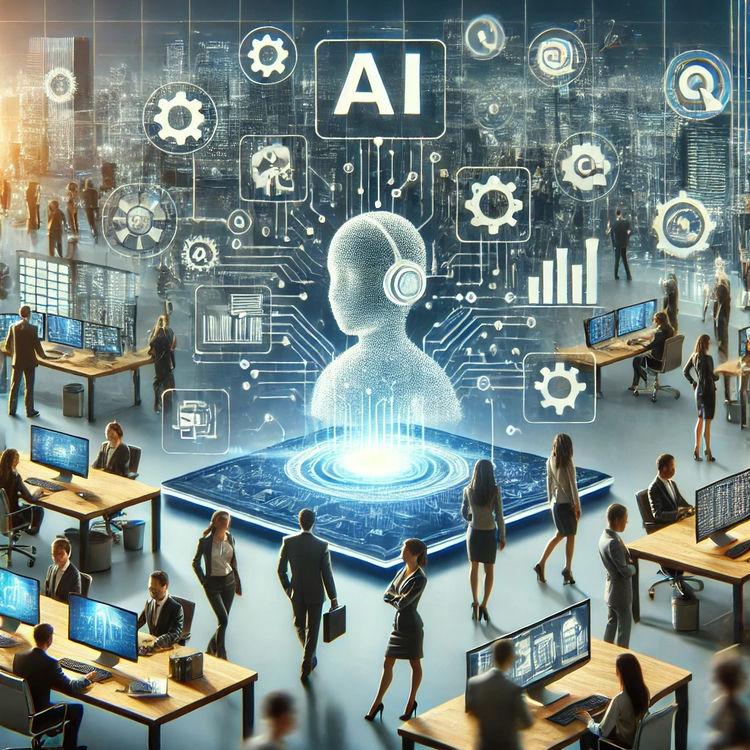
The Agentic Economy: When AI Agents Become Your Most Valuable Employees
The workplace is entering a new era where artificial intelligence is no longer limited to assisting employees - it is beginning to operate as a workforce in its own right. This transformation is giving rise to what many experts are calling the Agentic Economy, a future economic model where intelligent AI agents autonomously perform tasks, make decisions, coordinate workflows, and create measurable business value. In this emerging landscape, AI agents may become some of the most productive and valuable contributors within modern organizations.
Traditional automation systems were designed to execute predefined tasks. They followed rules, processed transactions, and handled repetitive operations. Agentic AI represents a significant evolution. These systems can understand objectives, reason through problems, interact with digital environments, and adapt their actions based on changing circumstances. Rather than simply responding to commands, AI agents can proactively pursue goals and collaborate with both humans and other intelligent systems.
In the agentic economy, organizations may deploy specialised AI agents across various business functions. A financial agent could analyse market trends and prepare investment recommendations. A cybersecurity agent might continuously monitor networks, investigate threats, and initiate defensive actions. A customer experience agent could personalise interactions and resolve support issues without human intervention. Together, these digital workers create an intelligent operational ecosystem that operates around the clock.
One of the most significant advantages of agentic systems is scalability. Unlike traditional employees, AI agents can operate simultaneously across multiple tasks, process vast amounts of information instantly, and maintain consistent performance without fatigue. This enables organizations to increase productivity while reducing operational delays and inefficiencies.
Organizations such as Microsoft and IBM are actively investing in agentic AI platforms that integrate autonomous decision-making, workflow orchestration, and business automation. These initiatives signal a shift toward enterprises where AI agents become embedded participants in everyday operations.
The agentic economy also introduces new opportunities for innovation. Businesses can create entirely new service models by combining human expertise with autonomous AI capabilities. Employees may increasingly focus on creativity, strategy, relationship-building, and governance while AI agents manage routine execution and data-intensive activities.
However, the rise of digital workers also raises important questions. Governance, accountability, and ethical oversight become critical when autonomous systems make decisions that affect customers, finances, or regulatory compliance. Organizations must establish clear boundaries, monitoring mechanisms, and transparency frameworks to ensure responsible AI deployment.
Workforce transformation is another major consideration. Rather than replacing humans entirely, agentic AI is more likely to redefine job roles and skill requirements. Employees who understand how to supervise, collaborate with, and optimise intelligent agents will become increasingly valuable.
Security remains equally important. Autonomous agents often access sensitive systems, data repositories, and operational processes. Strong identity management, access controls, and continuous monitoring are essential to prevent misuse or unauthorised actions.
In conclusion, the agentic economy represents a fundamental shift in how value is created and work is performed. As AI agents evolve from assistants to autonomous contributors, organizations will gain access to an intelligent digital workforce capable of driving productivity, innovation, and resilience at unprecedented scale. The most successful enterprises of the future may not simply employ people—they may orchestrate ecosystems in which humans and AI agents work together as partners.
#AgenticEconomy #AgenticAI #ArtificialIntelligence #FutureOfWork
#DigitalWorkforce #EnterpriseAI #BusinessAutomation #FutureTech #AutonomousAgents #DigitalTransformation #AIInnovation
#HumanAICollaboration
Author
Dr. Akhilesh Kumar
References
- Microsoft. Research on Agentic AI, Copilots, and Intelligent Enterprise Systems.
- IBM. Studies on Autonomous Business Operations and AI Agents.
- Gartner. Research on Agentic AI, Digital Labor, and Future Workforce Models.
- Institute of Electrical and Electronics Engineers. Research on Autonomous Intelligent Systems and Human-AI Collaboration.