
Beyond Moore's Law: Computing Architectures Built for the AI Era
For more than five decades, Moore's Law served as the guiding principle of the semiconductor industry. Proposed by Gordon Moore in 1965, it predicted that the number of transistors on an integrated circuit would roughly double every two years, delivering continuous improvements in computing performance while reducing cost. This remarkable trend fueled the digital revolution, enabling personal computers, smartphones, cloud computing, and the internet. However, as transistor miniaturisation approaches physical and economic limits, the industry is entering a new era. Instead of relying solely on smaller transistors, computing is being reinvented through entirely new architectures designed specifically for the demands of Artificial Intelligence (AI).
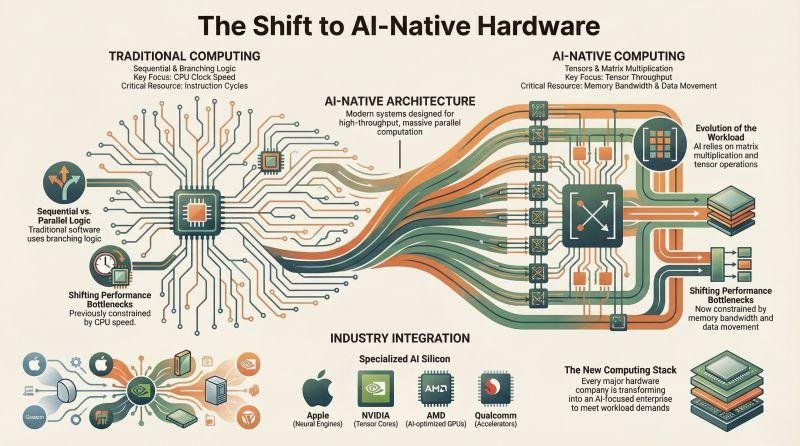
The AI revolution has fundamentally changed computing requirements. Unlike traditional business applications that perform sequential operations, AI workloads involve billions—or even trillions—of parallel mathematical calculations. Training foundation models, running autonomous systems, analysing medical images, and processing real-time sensor data require enormous computational throughput, vast memory bandwidth, and exceptional energy efficiency. Conventional Central Processing Units (CPUs), although highly versatile, are no longer sufficient to meet these specialised demands on their own.
As a result, the computing landscape is shifting toward heterogeneous architectures, where multiple specialised processors collaborate within a single computing platform. CPUs continue to manage general-purpose operations, while Graphics Processing Units (GPUs), Neural Processing Units (NPUs), Tensor Processing Units (TPUs), Digital Signal Processors (DSPs), and AI accelerators perform highly optimised machine learning tasks. This division of responsibilities enables systems to execute AI workloads more efficiently while reducing latency and power consumption.
One of the most significant architectural innovations is the adoption of chiplet-based design. Instead of manufacturing increasingly complex monolithic processors, chiplets divide functionality into smaller specialised components that are interconnected using ultra-high-speed communication technologies. Individual chiplets may handle computing, memory, networking, or AI acceleration independently while functioning together as a unified processor. This modular approach improves manufacturing flexibility, increases production yields, and accelerates innovation by allowing designers to combine the most suitable technologies for specific workloads.
Memory architecture is also undergoing profound transformation. Traditional computing requires constant movement of data between processors and memory, creating performance bottlenecks commonly referred to as the "memory wall." AI applications amplify this challenge because they continuously process massive datasets. Technologies such as High Bandwidth Memory (HBM), memory-centric computing, and processing-in-memory architectures reduce data movement by bringing computation closer to stored information, dramatically improving both performance and energy efficiency.
Edge computing represents another major shift. Rather than transmitting every piece of information to centralised cloud data centres, intelligent devices increasingly process AI workloads locally. Autonomous vehicles, industrial robots, medical equipment, smartphones, wearable devices, and smart manufacturing systems all require real-time decision-making with minimal latency. Specialised edge processors enable these devices to execute AI inference efficiently while preserving privacy and reducing dependence on network connectivity.
Artificial Intelligence itself is becoming a powerful tool for semiconductor innovation. AI algorithms now assist engineers in optimising processor layouts, improving chip verification, accelerating materials discovery, enhancing manufacturing quality, and identifying design improvements that would be difficult to achieve through conventional engineering methods. This creates a virtuous cycle in which AI continuously accelerates the evolution of the hardware required to run increasingly sophisticated AI applications.
Researchers are also exploring neuromorphic computing, an architecture inspired by the structure and operation of the human brain. Unlike traditional processors that execute sequential instructions, neuromorphic chips process information through interconnected artificial neurons and synapses. These systems excel at pattern recognition, sensory processing, and adaptive learning while consuming significantly less energy than conventional computing platforms. Although still emerging, neuromorphic computing holds promise for robotics, healthcare, autonomous systems, and edge AI applications.
Another transformative frontier is photonic computing. Instead of transmitting information through electrical signals, photonic processors use light to perform computation and communication. Optical technologies offer exceptional bandwidth, lower latency, and reduced heat generation, making them attractive for future AI data centers where enormous volumes of information must move rapidly between processors. As research advances, photonic computing may complement or augment electronic processors in high-performance AI environments.
Quantum computing also contributes to this architectural evolution. While quantum systems are unlikely to replace classical computers for general-purpose tasks, they offer unique advantages for optimisation, cryptography, molecular simulation, and certain machine learning algorithms. Hybrid quantum-classical architectures are expected to emerge, enabling organizations to use quantum processors selectively for problems where they provide measurable computational advantages.
Technology companies including NVIDIA, AMD, Intel, IBM, Google, and Arm are investing heavily in heterogeneous computing, AI accelerators, advanced packaging, neuromorphic research, and quantum technologies. Their innovations are shaping the computing platforms that will power the next generation of intelligent applications across healthcare, manufacturing, finance, transportation, cybersecurity, and scientific discovery.
Sustainability has become an equally important design objective. AI data centers consume significant amounts of electricity, making energy-efficient architectures essential for long-term growth. Future processors increasingly prioritise performance per watt rather than raw computational speed. Advanced cooling technologies, optimised instruction sets, low-power AI accelerators, and intelligent workload scheduling contribute to reducing environmental impact while supporting continued AI expansion.
Software innovation must evolve alongside hardware. Modern AI frameworks increasingly optimise workloads automatically for heterogeneous environments, enabling developers to harness specialised processors without managing low-level hardware complexity. This close integration between software and hardware ensures that architectural advances translate into real-world performance improvements.
Looking ahead, computing will become increasingly distributed, specialised, and intelligent. Rather than depending upon a single processor architecture, future systems will combine CPUs, GPUs, NPUs, neuromorphic chips, photonic processors, and quantum accelerators into unified computing ecosystems optimised for specific applications. These platforms will enable breakthroughs in personalised medicine, climate modeling, robotics, autonomous transportation, digital twins, and scientific research.
In conclusion, the future of computing extends far beyond Moore's Law. As transistor scaling approaches practical limits, innovation is shifting toward new architectures that emphasise specialisation, efficiency, intelligence, and collaboration among diverse computing technologies. Artificial Intelligence is not only driving demand for more powerful processors, but it is also fundamentally redefining how computers are designed. The next era of technological progress will be shaped not by making processors smaller, but by making computing architectures smarter, more adaptive, and purpose-built for the intelligence-driven world.
#BeyondMooresLaw #ArtificialIntelligence #ComputerArchitecture
#Semiconductors #AIChips #HighPerformanceComputing #EdgeAI
#NeuromorphicComputing #QuantumComputing #PhotonicComputing
#HeterogeneousComputing #Chiplets #TechnologyInnovation #FutureComputing #DigitalTransformation #AIEra #DrAkhileshKumar
Author: Dr. Akhilesh Kumar
References
- NVIDIA. Research on AI Accelerators, GPU Computing, and High-Performance AI Infrastructure.
- AMD. Chiplet Architectures and High-Performance Computing Technologies.
- Intel. Neuromorphic Computing, Edge AI, and Advanced Semiconductor Research.
- IBM. Quantum Computing and Next-Generation Computing Architectures.
- Google. Tensor Processing Units (TPUs) and AI Infrastructure Research.
- Arm. Edge Computing and Energy-Efficient Processor Architectures.
- Institute of Electrical and Electronics Engineers. Publications on Advanced Computing Architectures and Artificial Intelligence.
- Association for Computing Machinery. Research on Computer Architecture, AI Systems, and High-Performance Computing.
- Semiconductor Industry Association. Industry Reports on Future Semiconductor Technologies.
Comments (0)
No comments yet. Be the first to share your thoughts!
Leave a Comment