Precision Medicine Meets Artificial Intelligence: Personalizing Healthcare at Scale
Healthcare is undergoing a paradigm shift from standardised treatment protocols toward individualised care tailored to each patient's unique biological characteristics. This transformation, known as precision medicine, is redefining how diseases are prevented, diagnosed, and treated. At the same time, Artificial Intelligence (AI) is revolutionising the ability to analyse vast amounts of medical, genomic, and clinical data. Together, precision medicine and AI are creating an intelligent healthcare ecosystem capable of delivering personalised care at an unprecedented scale.
Traditional medicine has historically relied on generalised clinical guidelines developed from population-level studies. While these approaches have improved healthcare outcomes, patients often respond differently to identical treatments because of variations in genetics, lifestyle, environment, metabolism, and disease progression. Precision medicine seeks to address these differences by developing treatment strategies tailored to the individual rather than the average patient.
Artificial Intelligence has become the catalyst enabling precision medicine to move from research laboratories into routine clinical practice. Healthcare generates enormous volumes of information every day from electronic health records (EHRs) and laboratory reports to medical imaging, wearable device data, genomic sequencing, and real-time physiological monitoring. AI algorithms can process these diverse datasets rapidly, uncovering hidden relationships and clinically relevant patterns that would be difficult or impossible for humans to identify manually.
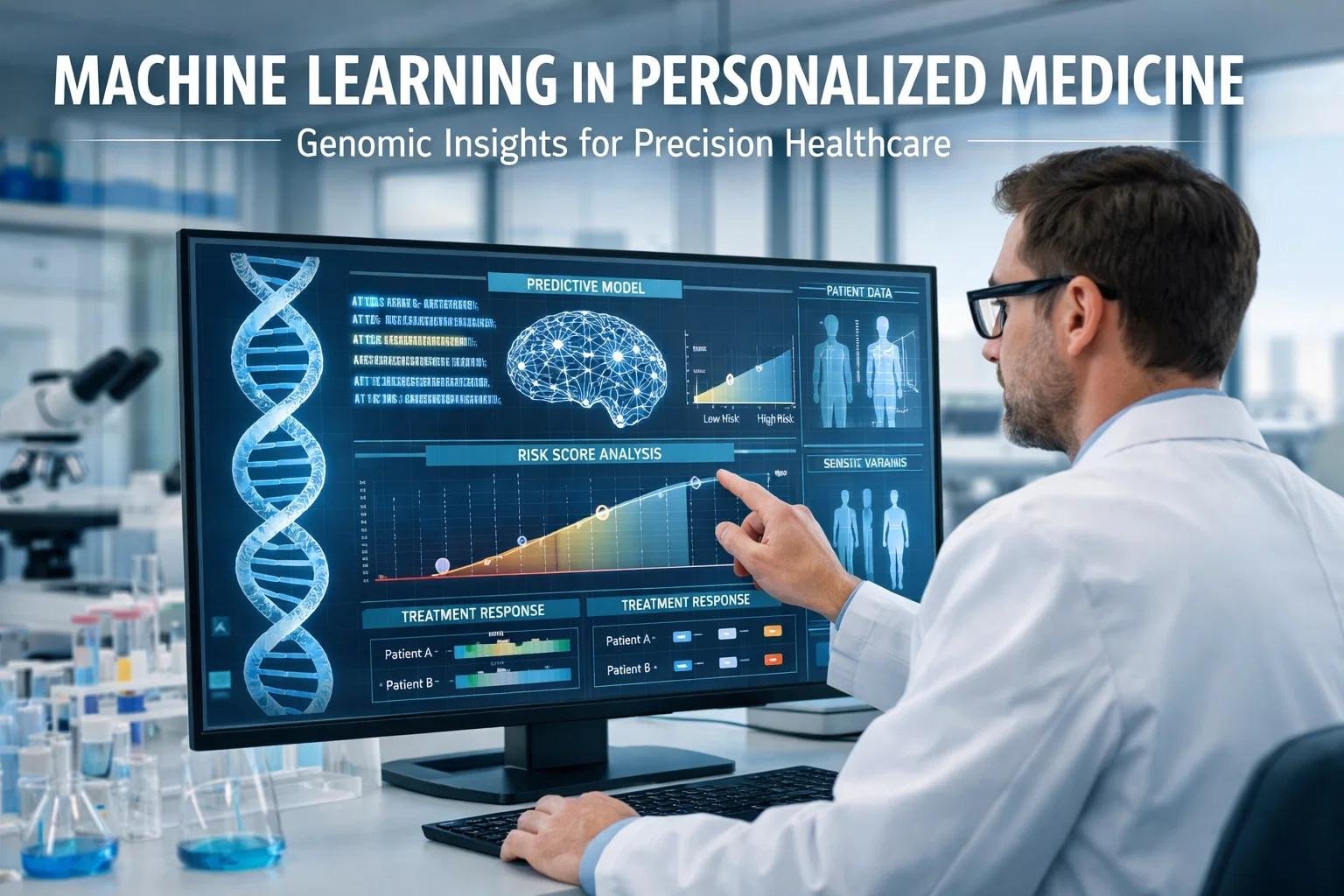
One of the most transformative applications of AI in precision medicine is genomics. Advances in next-generation sequencing have dramatically reduced the cost and time required to decode an individual's genetic information. However, interpreting genomic data remains extraordinarily complex. Machine learning models can analyse millions of genetic variants, identify disease-associated mutations, predict hereditary risks, and recommend targeted therapies based on a patient's molecular profile. This capability is accelerating personalised treatment strategies in oncology, rare diseases, cardiology, and inherited disorders.
Cancer care illustrates the power of this convergence. Rather than classifying tumours solely by their location, oncologists increasingly examine molecular and genetic characteristics to identify therapies most likely to benefit individual patients. AI assists by integrating genomic information with pathology images, radiological scans, clinical histories, and research literature to support precision oncology. Such approaches can improve treatment selection while minimising unnecessary therapies and adverse effects.
Beyond genomics, AI enhances precision medicine through predictive analytics. By analysing historical patient records, physiological measurements, medication histories, laboratory values, and lifestyle information, AI systems can estimate disease progression, predict hospital readmissions, identify patients at high risk for complications, and recommend preventive interventions before symptoms worsen. This proactive approach shifts healthcare from reactive disease management toward preventive and predictive care.
Wearable technologies and the Internet of Medical Things (IoMT) further strengthen personalised healthcare. Smartwatches, continuous glucose monitors, fitness trackers, blood pressure monitors, and remote cardiac monitoring devices generate continuous streams of health data. AI algorithms transform this real-time information into personalised clinical insights, enabling physicians to monitor patients remotely and adjust treatment plans according to changing physiological conditions.
Pharmacogenomics represents another rapidly advancing area. Individuals often metabolise medications differently because of genetic variations affecting drug absorption, distribution, metabolism, and elimination. AI can combine genomic data with clinical information to predict medication responses, optimise dosages, reduce adverse drug reactions, and improve therapeutic outcomes. This individualised approach supports safer and more effective prescribing practices.
Technology leaders such as Microsoft, Google, IBM, Illumina, and Tempus are investing heavily in AI platforms, genomic analytics, cloud healthcare infrastructure, and precision medicine solutions. Their innovations are helping researchers and healthcare providers accelerate discoveries while bringing personalised medicine closer to everyday clinical practice.
Despite remarkable progress, precision medicine also presents significant challenges. Healthcare organizations must ensure patient privacy, protect sensitive genomic information, maintain data quality, eliminate algorithmic bias, and comply with evolving ethical and regulatory requirements. Interoperability among healthcare systems remains another critical obstacle, as precision medicine depends on integrating data from multiple sources into a unified clinical framework.
Equitable access is equally important. Advanced genomic testing and AI-powered diagnostics should benefit patients across diverse populations rather than being limited to specialised healthcare centres or high-income communities. Expanding infrastructure, reducing costs, and increasing workforce expertise will be essential to making personalised healthcare widely accessible.
The future of precision medicine will extend beyond genomics. Multi-omics approaches, including proteomics, metabolomics, microbiomics, and transcriptomics, will combine with AI to provide a comprehensive understanding of human health. Digital twins may simulate individual patient responses to therapies before treatment begins, while generative AI could support personalised clinical recommendations based on continuously evolving evidence. Together, these innovations will create adaptive healthcare systems capable of delivering highly individualised care throughout a patient's lifetime.
Importantly, AI will enhance, not replace, the expertise of healthcare professionals. Physicians, genetic counsellors, pharmacists, nurses, and researchers will continue to play central roles in interpreting AI-generated insights, communicating complex information, and making patient-centred clinical decisions. Human judgment, empathy, and ethical reasoning remain irreplaceable elements of quality healthcare.
In conclusion, the convergence of precision medicine and artificial intelligence represents one of the most significant advancements in modern healthcare. By combining genomic science, predictive analytics, continuous monitoring, and intelligent decision support, AI enables personalised medicine to be delivered efficiently and at scale. As technology continues to evolve, healthcare will become increasingly proactive, predictive, preventive, and personalised. Organizations that embrace this transformation responsibly will help shape a future where every patient receives care tailored not only to their disease but also to their unique biological identity.
#PrecisionMedicine #ArtificialIntelligence #PersonalizedHealthcare #Genomics #AIHealthcare #DigitalHealth #PredictiveAnalytics
#PrecisionOncology #HealthTech #ClinicalAI #FutureOfHealthcare
#MedicalInnovation #HealthcareTransformation #GenomicMedicine
#SmartHealthcare #DrAkhileshKumar
Author: Dr. Akhilesh Kumar
References
- National Institutes of Health. All of Us Research Program and Precision Medicine Research.
- World Health Organization. Global Digital Health Strategy and AI in Healthcare.
- Microsoft. AI for Health and Cloud Healthcare Solutions.
- Google. AI Research in Precision Medicine and Healthcare.
- IBM. Artificial Intelligence for Clinical Decision Support.
- Illumina. Genomic Sequencing and Precision Medicine Technologies.
- Tempus. AI-Driven Precision Oncology and Clinical Data Analytics.
- Institute of Electrical and Electronics Engineers. Research on AI, Precision Medicine, and Biomedical Informatics.
- Healthcare Information and Management Systems Society. Digital Health and Personalized Healthcare Frameworks
Comments (0)
No comments yet. Be the first to share your thoughts!
Leave a Comment