
Quantum-Safe Cybersecurity: Preparing for the Post-Encryption Era
The digital economy is built on trust, and that trust is secured by cryptography. Every online banking transaction, confidential email, digital signature, healthcare record, and cloud-based application depends on encryption algorithms that protect sensitive information from unauthorised access. For decades, these cryptographic standards have served as the backbone of cybersecurity. However, the rapid advancement of quantum computing is challenging this foundation, ushering in what many experts describe as the post-encryption era. To remain secure in the coming decades, organisations must begin preparing today through quantum-safe cybersecurity.
Unlike classical computers, which process information using binary bits represented as either 0 or 1, quantum computers operate using quantum bits, or qubits. Through the principles of superposition and entanglement, qubits can perform multiple calculations simultaneously, enabling quantum systems to solve certain mathematical problems exponentially faster than conventional computers. Although practical, large-scale quantum computers are still under development, their potential to break widely used public-key cryptographic algorithms has made quantum readiness a strategic priority for governments, enterprises, and researchers worldwide.
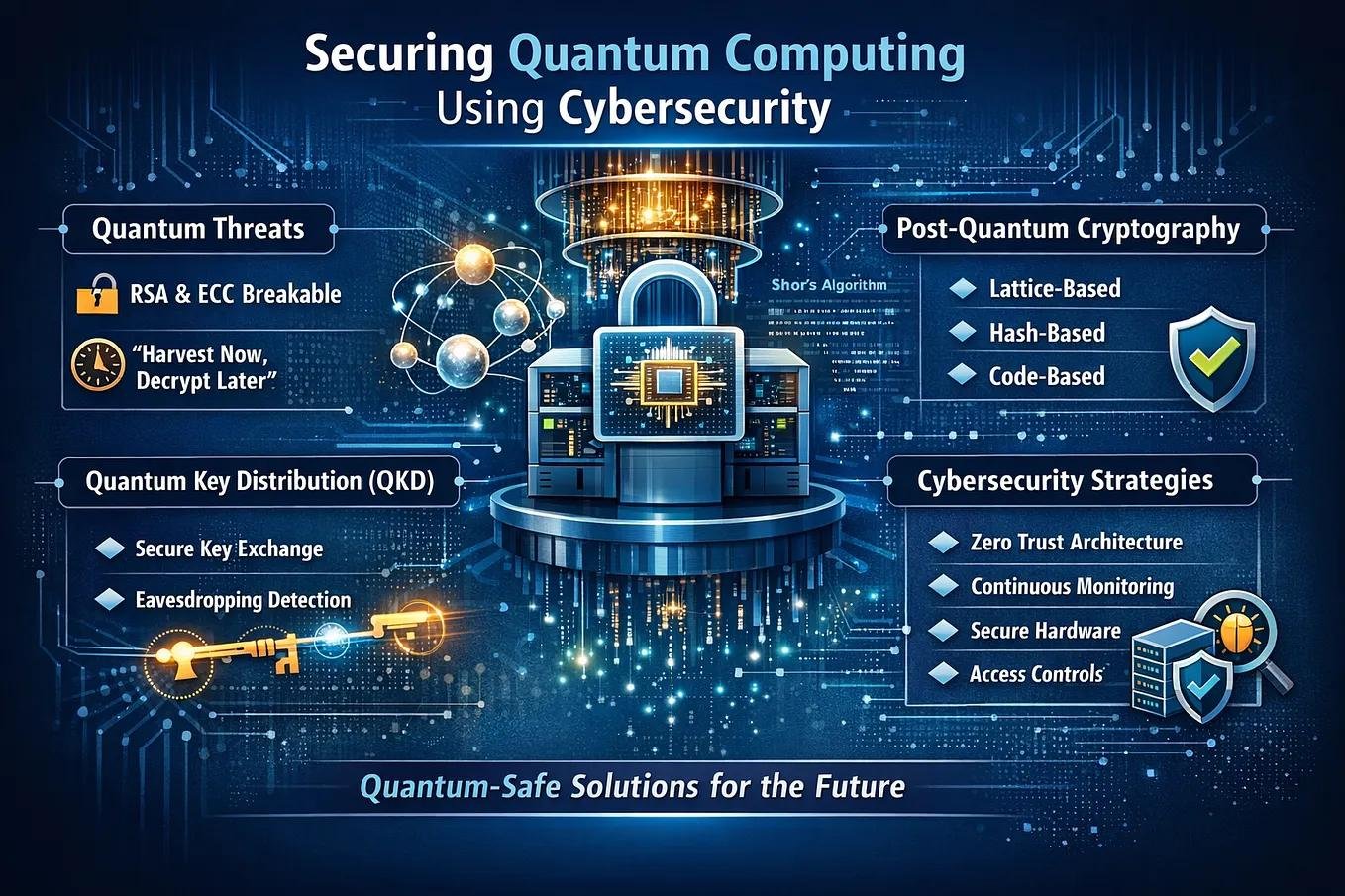
Most modern digital security relies on cryptographic algorithms such as RSA and Elliptic Curve Cryptography (ECC). These algorithms derive their strength from the computational difficulty of factoring large integers or solving discrete logarithm problems using classical computers. A sufficiently capable quantum computer, however, could theoretically solve these problems efficiently using Shor’s Algorithm, rendering many of today’s encryption standards vulnerable. This would affect digital certificates, virtual private networks (VPNs), secure web communications, blockchain technologies, software signing, financial systems, and countless enterprise applications.
One of the most concerning threats is known as "Harvest Now, Decrypt Later." Cyber adversaries may already be collecting encrypted communications and storing them with the expectation that future quantum computers will eventually decrypt the data. Information with long-term confidentiality requirements, including government communications, intellectual property, healthcare records, defence data, and financial transactions, could therefore be exposed years after it was originally transmitted. This risk makes quantum preparedness an immediate cybersecurity concern rather than a distant technological challenge.
To address these emerging threats, cybersecurity is entering a new phase centred on Post-Quantum Cryptography (PQC). Unlike quantum encryption, PQC focuses on developing cryptographic algorithms that remain secure against attacks from both classical and quantum computers. These algorithms are designed using mathematical problems believed to be resistant to quantum attacks, such as lattice-based cryptography, code-based cryptography, multivariate polynomial cryptography, and hash-based digital signatures.
Significant progress has already been made in this area. National Institute of Standards and Technology has completed a multi-year global effort to evaluate and standardise quantum-resistant cryptographic algorithms. These standards provide governments and enterprises with a roadmap for gradually replacing vulnerable encryption methods while maintaining interoperability across digital systems. The transition to quantum-safe cryptography is expected to become one of the largest cybersecurity modernisation efforts in history.
Quantum-safe cybersecurity extends beyond replacing cryptographic algorithms. Organisations must first identify where vulnerable encryption exists throughout their digital infrastructure. This process, often referred to as cryptographic inventory or cryptographic discovery, involves cataloguing encryption protocols, digital certificates, authentication systems, APIs, databases, IoT devices, cloud services, and software applications. Without visibility into existing cryptographic assets, planning an effective migration becomes nearly impossible.
Another critical concept is crypto agility, the ability to replace cryptographic algorithms rapidly without redesigning entire applications or infrastructure. As quantum-resistant standards continue to evolve, organizations need flexible architectures capable of supporting multiple cryptographic algorithms and adapting to future security requirements. Crypto agility reduces migration complexity while improving long-term resilience against emerging threats.
Cloud computing providers and enterprise technology vendors are already integrating quantum-safe capabilities into their platforms. Companies such as Google, IBM, Microsoft, and Cloudflare are actively researching and testing post-quantum cryptographic implementations across cloud services, networking infrastructure, secure communications, and identity management. These initiatives are helping organizations prepare for a gradual transition rather than a disruptive replacement.
Artificial intelligence also plays an increasingly important role in quantum-safe cybersecurity. AI-driven security platforms can identify cryptographic vulnerabilities, prioritise migration activities, monitor encryption compliance, detect anomalous network behaviour, and automate policy enforcement across complex enterprise environments. Combining AI with quantum-resistant cryptography enables organizations to strengthen both operational efficiency and long-term cyber resilience.
Despite promising advances, the migration to quantum-safe cybersecurity presents several challenges. Legacy systems may not support modern cryptographic standards, and replacing embedded encryption across industrial control systems, healthcare equipment, financial platforms, and connected devices can require significant planning and investment. Organizations must also balance security improvements with performance, interoperability, regulatory compliance, and operational continuity.
The workforce dimension is equally important. Cybersecurity professionals, software engineers, enterprise architects, compliance teams, and executive leadership must develop a shared understanding of quantum risk and cryptographic modernisation. Investment in workforce education, governance frameworks, and long-term cybersecurity planning will determine how effectively organizations navigate the transition.
Looking ahead, the future of cybersecurity will be defined not only by stronger encryption but also by adaptive security architectures capable of evolving alongside technological advances. Quantum computing promises extraordinary benefits for scientific discovery, healthcare, optimisation, and materials research. At the same time, it requires organizations to rethink fundamental assumptions about digital trust and information protection. Enterprises that begin preparing today will be significantly better positioned to secure their digital assets in a post-quantum world.
In conclusion, quantum-safe cybersecurity is no longer a theoretical discussion, it is a strategic imperative. The arrival of quantum computing may fundamentally transform modern cryptography, but proactive preparation can significantly reduce future risks. By embracing post-quantum cryptography, crypto agility, AI-assisted security, and continuous modernisation, organizations can build resilient digital infrastructures capable of protecting sensitive information well into the quantum era. The question is no longer whether enterprises should prepare for quantum cybersecurity, it is how quickly they can begin the journey.
#QuantumComputing #QuantumSafe #PostQuantumCryptography
#CyberSecurity #Encryption #QuantumSecurity #InformationSecurity #DigitalTrust #EnterpriseSecurity #CloudSecurity #ArtificialIntelligence
#TechnologyInnovation #FutureOfCyberSecurity #CryptoAgility
#DrAkhileshKumar
Author: Dr. Akhilesh Kumar
References
- National Institute of Standards and Technology. Post-Quantum Cryptography Standards and SP 800-208 guidance.
- National Security Agency. Commercial National Security Algorithm Suite 2.0 (CNSA 2.0) guidance for quantum-resistant cryptography.
- IBM. Research on Quantum Computing and Quantum-Safe Cryptography.
- Google. Research on Post-Quantum Cryptography and Secure Internet Protocols.
- Microsoft. Quantum Computing Research and Azure Quantum initiatives.
- Cloudflare. Deployment of Post-Quantum Cryptography for Internet Security.
- Institute of Electrical and Electronics Engineers. Publications on Quantum Computing and Cybersecurity.
- European Union Agency for Cybersecurity. Guidance on Quantum-Safe Cryptography and Future Cybersecurity.
Comments (0)
No comments yet. Be the first to share your thoughts!
Leave a Comment