
The Next Generation of Smart Hospitals: Where Every Device Thinks
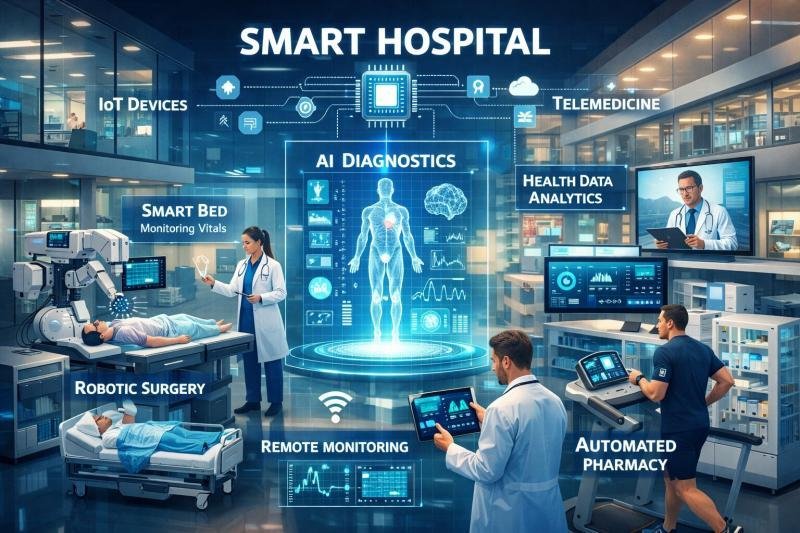
Healthcare is entering an era in which intelligence is no longer limited to physicians, nurses, or hospital information systems. The next generation of hospitals will be environments where every connected device from patient monitors and infusion pumps to imaging systems and surgical robots can sense, communicate, analyse, and respond intelligently. Powered by Artificial Intelligence (AI), the Internet of Medical Things (IoMT), edge computing, robotics, cloud platforms, and digital twins, these smart hospitals are redefining how healthcare is delivered, managed, and experienced.
For decades, hospitals have invested in digitisation through Electronic Health Records (EHRs), Picture Archiving and Communication Systems (PACS), Hospital Information Systems (HIS), and telemedicine platforms. While these technologies improved data accessibility, they often functioned independently. The next generation of smart hospitals moves beyond digitisation toward intelligent orchestration, where every connected asset continuously shares information and contributes to clinical and operational decision-making in real time.
At the centre of this transformation is the Internet of Medical Things (IoMT). Modern hospitals deploy thousands of connected devices, including patient monitors, infusion pumps, ventilators, wearable sensors, imaging equipment, laboratory analysers, smart beds, medication dispensing systems, and environmental sensors. Traditionally, these devices generated isolated streams of data. Today, AI integrates and interprets this information to create a comprehensive, continuously updated view of patient health and hospital operations.
Imagine an intensive care unit where patient monitors continuously analyse heart rhythm, respiratory rate, oxygen saturation, blood pressure, and temperature. Instead of merely displaying measurements, AI algorithms detect subtle physiological changes that may indicate sepsis, cardiac deterioration, or respiratory failure hours before conventional clinical signs appear. Clinicians receive early warnings, enabling timely intervention that can improve patient outcomes and reduce complications.
Artificial Intelligence is also transforming medical imaging. AI-assisted diagnostic systems rapidly analyse radiological images, pathology slides, and ultrasound scans to identify abnormalities that may otherwise remain undetected. Rather than replacing radiologists or pathologists, these intelligent systems prioritise urgent cases, reduce interpretation time, and provide decision support that enhances diagnostic accuracy.
Edge computing further strengthens intelligent hospitals by processing data directly on medical devices or local infrastructure instead of relying exclusively on centralised cloud servers. This approach enables near-instantaneous clinical decision-making while reducing network latency. For critical applications such as intensive care monitoring, robotic surgery, and emergency medicine, real-time processing can significantly improve patient safety.
Robotics is another defining characteristic of next-generation hospitals. Autonomous mobile robots transport medications, laboratory specimens, linens, and medical supplies throughout healthcare facilities, reducing manual workload and improving logistical efficiency. Surgical robots provide exceptional precision during minimally invasive procedures, while rehabilitation robots assist patients recovering from neurological injuries, orthopaedic surgeries, or stroke. AI enables these robotic systems to adapt continuously to changing clinical environments while supporting healthcare professionals rather than replacing them.
One of the most promising innovations is the integration of digital twins into hospital management. A digital twin is a virtual representation of a physical environment that updates continuously using real-time operational data. Hospital administrators can simulate patient flow, optimise emergency department capacity, evaluate staffing strategies, predict equipment failures, and test disaster response scenarios without disrupting actual clinical operations. These predictive insights improve resource allocation while enhancing organizational resilience.
Smart hospitals also redefine patient experience. AI-powered virtual assistants help patients schedule appointments, access medical records, receive medication reminders, navigate hospital facilities, and obtain personalised health education. Wearable technologies continuously monitor recovery after discharge, allowing clinicians to identify complications early and reducing unnecessary readmissions. The hospital effectively extends into patients' homes through connected care ecosystems.
Technology leaders such as Microsoft, Google, IBM, Siemens Healthineers, GE HealthCare, and Philips are driving innovation in AI-assisted diagnostics, connected medical devices, intelligent imaging, cloud healthcare platforms, and hospital automation. Their investments continue to accelerate the evolution of intelligent healthcare infrastructure worldwide.
However, increasing connectivity also introduces new cybersecurity challenges. Every connected medical device represents a potential entry point for cyber threats. Protecting hospital networks therefore requires Zero Trust Architecture, continuous identity verification, secure device lifecycle management, encryption, network segmentation, vulnerability management, and AI-powered threat detection. Cyber resilience must be embedded into every intelligent healthcare system from its initial design.
Data interoperability remains another significant priority. Smart hospitals depend on seamless communication between EHR systems, laboratory platforms, imaging technologies, pharmacy systems, wearable devices, and external healthcare providers. International interoperability standards enable information to flow securely across diverse digital ecosystems while preserving patient privacy and regulatory compliance.
The healthcare workforce will evolve alongside these technologies. Physicians, nurses, biomedical engineers, IT specialists, and hospital administrators will increasingly collaborate with intelligent systems that automate routine tasks, generate predictive insights, and support clinical decision-making. Human expertise, empathy, ethical reasoning, and patient communication will remain central to healthcare, while AI enhances efficiency and precision.
Looking toward the future, the intelligent hospital will become a continuously learning healthcare ecosystem. Advances in generative AI, ambient clinical intelligence, digital biomarkers, precision medicine, quantum computing, and autonomous robotics will converge to create hospitals capable of anticipating clinical needs rather than merely responding to them. Every connected device will contribute to a collective intelligence that supports safer, faster, and more personalised patient care.
In conclusion, the next generation of smart hospitals represents far more than technological modernisation. It is the creation of intelligent healthcare environments where every connected device contributes meaningful insights, supports clinical excellence, and enhances patient outcomes. As AI, robotics, digital twins, and connected medical technologies continue to mature, hospitals will become adaptive ecosystems capable of delivering healthcare that is predictive, personalised, efficient, and resilient. The hospitals of tomorrow will not simply be digital, they will be intelligent.
#SmartHospital #IntelligentHospital #ArtificialIntelligence #DigitalHealth
#InternetOfMedicalThings #IoMT #MedicalRobotics #DigitalTwins
#HealthcareInnovation #ConnectedCare #AIHealthcare #HealthTech
#FutureOfHealthcare #ClinicalAI #HospitalTransformation #MedicalTechnology #DrAkhileshKumar
Author: Dr. Akhilesh Kumar
References
- World Health Organization. Global Strategy on Digital Health 2020–2025.
- National Institutes of Health. Research on AI, Digital Health, and Connected Healthcare Systems.
- Microsoft. Cloud for Healthcare and AI Innovation.
- Google. Healthcare AI Research and Medical Intelligence.
- IBM. AI for Clinical Decision Support and Intelligent Healthcare.
- Siemens Healthineers. Smart Hospital Technologies and AI-Driven Imaging.
- GE HealthCare. Connected Care, Intelligent Diagnostics, and Hospital Innovation.
- Philips. Internet of Medical Things (IoMT) and Connected Care Solutions.
- Institute of Electrical and Electronics Engineers. Publications on Medical IoT, Smart Hospitals, Artificial Intelligence, and Healthcare Robotics.
Comments (0)
No comments yet. Be the first to share your thoughts!
Leave a Comment